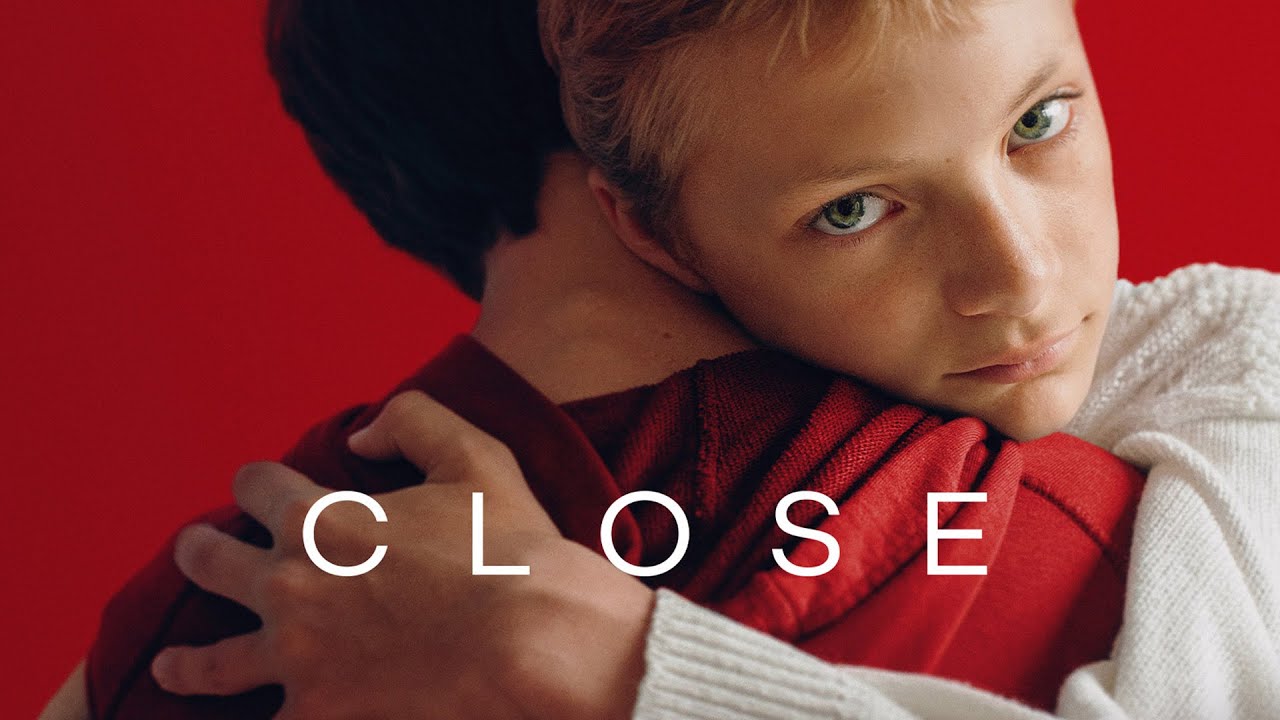
BEING CLOSE: THE CAPACITY TO HOLD CONFLICTING EMOTIONS TOGETHER

“Imagine that you are a very small chicken. You just hatched. You just opened your eyes for the first time. All ducks are yellow. And you too... But you are much more beautiful than the rest. You are special. You’re wondering what it is, as you’ve never seen one before. You think that lizard is odd, and it rhymes too, but you like it. Because its colour is special, just like you. One day, you leave together, and you end up on a trampoline. You start jumping on the trampoline. You jump as high as the stars. ”
In the film Close (2022), our thirteen-year-old Leo tells this story to Remi to sleep. It is an invented tale that encapsulates the intense affection between Leo and Remi, an affection we sense deeply but which never quite finds expression in words. In just ten sentences, the story carries a multitude of emotions: curiosity, uncanny, admiration, excitement, and courage.

As the title of the film “Close” suggests, the film unfolds through the story of two friends whose emotional closeness to one another is unmistakable. But what does it really mean to be close to someone? The film answers this question through the relationships formed by characters who experience many emotions intertwined within one another. We can clearly see the closeness between Leo and Remi in the scenes where they run and laugh together. Yet we also feel it in the moment when their frustration turns into aggression, and they disguise their desire for closeness through a pillow fight. It is a scene as real as the frustration we feel when our mother cannot be wholly ours, when she cannot meet all our needs, alongside the attachment we continue to feel toward her despite that frustration.
Because we often struggle to hold such opposing experiences together, we tend to deny certain aspects of what we feel. When the contradictions within us fail to reconcile, instead of relationships where we can reveal ourselves honestly and form genuine closeness, something else begins to emerge: burdens we keep to ourselves, burdens we eventually believe we carry alone. When this happens, our relationships cease to be spaces for contact and instead become ways of sustaining our psychological solitude.
How telling it is that the word close means not only “near,” but also “closed,” “to shut.” All those negative feelings we try to push outside the door because we believe they threaten our closeness with the ones we love, in fact, do the opposite: they close us off from the possibility of true closeness.
Because we often struggle to hold such opposing experiences together, we tend to deny certain aspects of what we feel. When the contradictions within us fail to reconcile, instead of relationships where we can reveal ourselves honestly and form genuine closeness, something else begins to emerge: burdens we keep to ourselves, burdens we eventually believe we carry alone. When this happens, our relationships cease to be spaces for contact and instead become ways of sustaining our psychological solitude. How telling it is that the word close means not only “near,” but also “closed,” “to shut.” All those negative feelings we try to push outside the door because we believe they threaten our closeness with the ones we love, in fact, do the opposite: they close us off from the possibility of true closeness. Our ability to feel sincerely close depends on our capacity to contain contradictory emotions within us. After losing Remi, the range of emotions Leo experiences shows us that grief, the price of loving someone, contains many complex feelings at once. In the days after the loss, Leo returns to school and tries to continue with his daily routine. Yet we also see signs of psychological regression in the scenes where he realizes he has wet the bed during the night and goes to sleep beside his older brother. In one moment, he is outside playing in the snow with friends, laughing and enjoying himself. Moments later, he grows angry at those same friends when they make comments about Remi, aware that Leo was there. At one point, he invites a friend to his house, just as he once did with Remi; they spend a pleasant day together. But when night falls, and he looks at his sleeping friend, he misses Remi deeply, and the next day he goes to Remi’s house. At the end-of-term party, his smile toward his friends enjoying themselves is real; yet so is the sadness in his eyes as he feels Remi’s absence. We never see Leo openly shout, protest, or verbalize his inner pain. Yet somehow, he ends up breaking his arm, and it is only in that moment that we finally see him cry. By the second half of the film, we already know that Leo feels guilty, sad, angry, and that he still loves and misses his friend deeply. This film, which symbolically acknowledges the natural contradictions of life by making Remi’s mother, a woman who has lost her son, a midwife who assists births, reminds us of something essential: that feeling both close and distant in our relationships is part of loving itself.